


_edited.jpg)
The Use of Tomatillo Husks As Leavening Agent To Provide Textural Benefits For Pasta Making and Baking
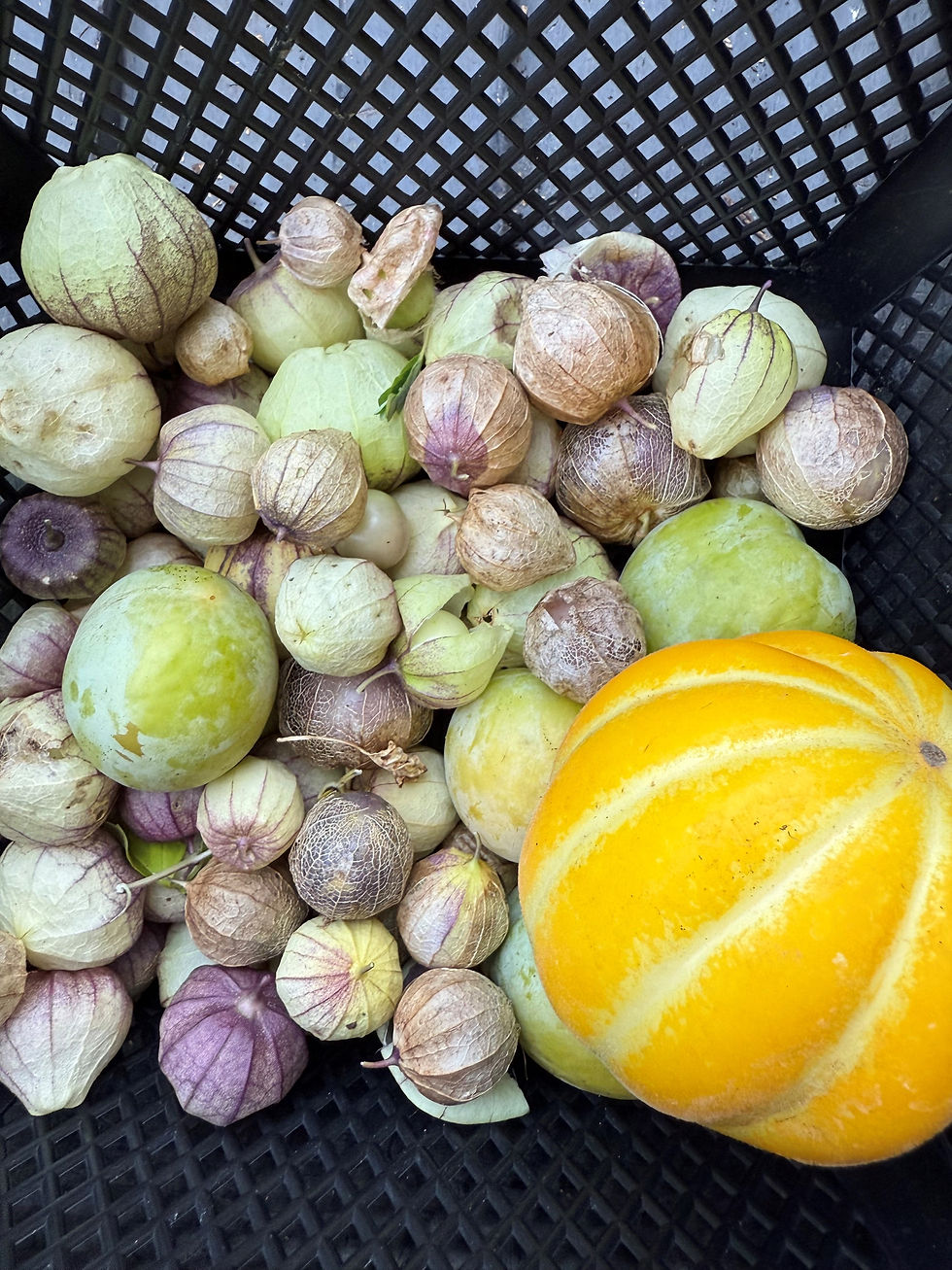
Fresh made pasta is delicious! At Suis Generis, we mill whole grain heirloom wheat to create fresh flour with more nutrients and anti-oxidants than months-old store bought pre-milled flour.[1] We think about these things in both the realms of flavor and nutritional content.
Several weeks ago, we started harvesting tomatillos. In line with our zero-waste cooking model, when shucking the outer husks from the beautiful green, gold and purple tomatillos, we wondered how the husks could be incorporated into the menu. I had a general recollection that ancient Central American cultures used tomatillo husks to condition cornmeal for tortillas, before calcium hydroxide (cal) based nixtamalization existed. This made me think that the ability of tomatillo husks to unlock nutrients, enhance calcium, and to transform and soften starches would be useful in pasta making.
Brief History of Tomatillos
Research indicates tomatillos (Physalis Ixocarpa), also called green tomatoes, or husk tomatoes were first domesticated around 800 bce by early Central American cultures, such as the Aztec, Mayan and Olmec.[2] Such cultures used tomatillos as we use limes, which were not introduced until the Spanish colonials appeared in the 16th century.[3]
Why Tomatillos May Make Pasta Tastier & More Nutritious
Traditional semolina wheat-based pasta is rich in carbohydrates, but generally lacks bioactive compounds such as proteins and a full range of amino acids.[4] It also lacks dietary fiber and micronutrients.[5]
Our focus on eliminating food waste opens the door to creativity – including the use of veggie “refuse” to make pasta. Staggeringly, food waste can approach 30% of the total food produced globally.[6] We know that from real-life experience – seeing that kind of waste in traditional restaurants pains our soul. We also know much of the “refuse” is nutritious and delicious, and should not be simply discarded. In fact, much of this “refuse” contains a large amount of beneficial compounds such as fiber, phytochemicals, protein, fatty acids, vitamins and minerals, that can be incorporated into pasta making practices.[7]
This article focuses on tomatillo husks, but banana peels are also worthy of note, because they are rich in dietary fiber, minerals and bioactive compounds, which make them an interesting candidate as a sustainable waste-minimizing functional food product.[8] Banana peels are traditionally used to treat burns, inflammation, ulcers, diarrhea, and diabetes.[9] Studies recommended the addition of banana peel powder in the amount of 5% of the wight of flower for making pastas more nutritious.[10] Plus, since we grow lots of bananas at our SG Tiki Farm, and make a lot of pasta at Suis Generis, that’s good news!
Tomatillo Husks can be used as a leavener
First off, what do leaveners do? Interestingly, the answer involves a bit of complexity, because there are both mechanical and chemical leaveners. Mechanical leaveners (also referred to as biological leaveners), such as yeast, trap gas in doughs and batters, causing expansion and lightness, and creating softness in the finished product. Meanwhile, chemical leaveners like baking soda and baking powder, react with acids to create carbon dioxide bubbles. In other words, yeast eats sugars and excretes carbon dioxide, while chemical leaveners do the same through chemical reactions.
The theory that we are examining here is as follows: Steeping tomatillo husks in hot water creates an acidic, nutrient-rich broth that may significantly improve the texture and pliability of pasta and doughs.
The Science Behind The Shell
Tomatillo husks (also called the “cuticles”) contain vitamins, minerals, phenolic compounds, steroidal lactones, and also having antimicrobial activity and antinarcotic effects.[11] In particular, the husks contain a matrix of cutin and wax forming a membrane of polymerized lipids and epoxylated long-chain fatty acids, as well as polysaccharides.[12]
Tomatillo husks also have a high Cutin content. It is a tough, wax-like biopolymer that forms the outer protective layer of fruits, leaves and vegetables. In the technical context, cutin is an insoluble polymer conformed by long-chain fatty acids that are hydroxylated and, in some cases, also epoxylated.[13] Also present are large amounts of hydroxyl groups of antioxidants (one O2 and one H atom), which increase the hydrophilic character of ingredients such as doughs, resulting in greater elasticity.[14] In English, that means the hydroxyl groups are very water soluble, meaning they retain moisture and are great in balancing sugar/starch compositions.
One chemistry-related question that is unclear from the current research on tomatillo husks: when simmered, is it the acid or the pectins contained in the tomatillo husks that are released into the water solution?
There is some evidence that acid boils off, but the pectins are loosened from the cells during boiling.[15] While pectin is not a leavener, it is a dough conditioner, acting on gluten to strengthen the bonds and allowing the dough to latch on to carbon dioxide produced by other leavening agents (ie: yeast or baking soda). Pectin also aids in the retention of moisture, which increase the rise and quality of baked goods. So, the pectins in tomatillo husks create a double-beneficial effect on the dough, both accentuating the leavening process and conditioning the dough.
The acid found in tomatillo husks (specifically malic and citric acid) acts to break down starches, which also may produce a leavening effect.
Another substance found in tomatillos is a mineral salt called tequesquite, which is thought to act in a similar manner as baking soda and vinegar to create a chemical reaction to release carbon dioxide. Thus, it may be the tequesquite which is the actual leavening agent in the husk.[16]
In summary, he acidic nature of tomatillo husks promotes pliability by relaxing starches, which increases the elasticity of the dough. Meanwhile, the pectins enhance the softness of the dough, making the pasta softer. Finally, the other chemical compounds promote the binding of flower and water particles, reducing the need for additional binding materials (like egg or flax seed mash). Tomatillo husks have an additional bonus benefit in their antioxidant properties. The phenolic compounds, flavonoids and steroidal lactones have been recognized for their strong health benefits, which you don’t get from traditional pasta dough.[17]
Our Tests With Biang Biang Noodles:
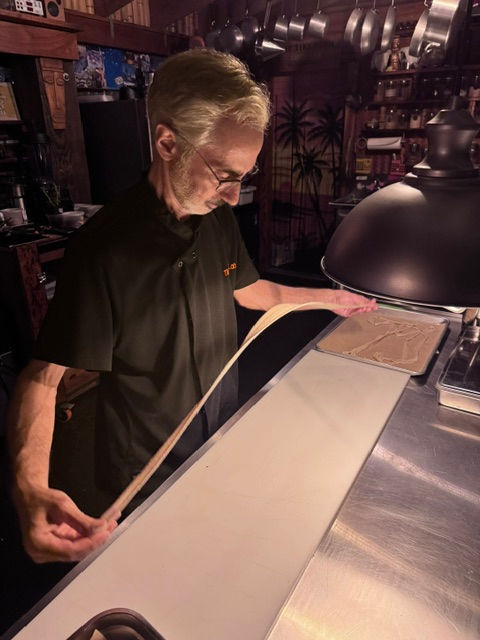
We have been experimenting with the inclusion of tomatillo husk water for making hand pulled biang biang noodles, and the initial results are almost staggering. Where the noodles made without the tomatillo husks stretch reasonably well, their breaking point is much lower than the dough with tomatillo husk water. In fact, the tomatillo husk water dough seems to exhibit about a 50+ increase in stretch and bounce. While our studies continue, the initial results are overwhelmingly positive.
Conclusion:
Tomatillo husk water appears to be very effective as a natural pH enhancer and dough tenderizer, resulting in a highly pliable, soft, and crack-free pasta dough that is much easier to roll, pull, and shape.
Future Considerations:
Is it better to make simmered tomatillo husk water or dry it into a powder to incorporate into pastas – or both? Maybe the acid remains intact under low temp dehydration? To date, we have conducted studies on the use of boiled tomatillo husks. We also need to evaluate the effects of dehydrated and powdered husks in pasta flour mixes to see if they have a greater or lesser benefit than the husk water.
Can the same properties discussed here be used to tenderize meats? We think so, but again, more testing in that area is needed.
But we look forward to that research as well!
Article By: Chef Ernie Foundas
[1] See, for example, Yaoguang, et al., “Total phenolic, flavonoid content, and antioxidant activity of flour, noodles, and steamed bread made from different colored wheat grains by three milling methods,” The Crop Journal, Vol. 3, Issue 4, August 2015, pp. 328-334 (stating that pasta and bread made from refined flour has 23-32% less phenolic and flavonoid, and antioxidant content than fresh milled whole wheat flours).
[3] Id.
[4] See, Bianchi et al., “Technological, nutritional and sensory properties of pasta fortified with agro-industrial by-products: a review,” Intl. J Food Science & Technology, June 14, 2021.
[5] S. Selvarani, “Development and Evaluation of Functional Pasta Enriched With Banana Peel Powder and Dried Vegetables,” Intl. J. of Home Science, 2026, 12(1): 125-127.
[6] Id., Bianchi.
[7] Id., Bianchi.
[8] S. Selvarani, “Development and Evaluation of Functional Pasta Enriched With Banana Peel Powder and Dried Vegetables,” Intl. J. of Home Science, 2026, 12(1): 125-127.
[9] Id., Selvarani.
[10] Id., Selvarani.
[11] Arrieta-Baez, et al., “Structural Studies of Mexican Husk Tomato (Physalis ixocarpa) Fruit Cutin,” Molecules, 2023 Dec 28: 29(1):184.doi.
[12] Id.
[13] Id., Arrieta-Baez.
[14] Id., Arrieta-Baez.
[15] Morales-Contreras, et al., “Pectin from Husk Tomato (Physalis ixocarpa Brot.): Rheological behavior at different extraction conditions,” Carbohydrate Polymers, Vol. 179, 1 Jan. 2018, pp. 282-289.
[16] See, for example, https://masaamerica.com/2020/11/23/tequesquite/
[17] Aguiar-Mendoza, et al., “Sonication-Extracted Polyphenols From Tomatillo Calyx Waste: A Novel Approach To Enhancing Antioxidant And Antimicrobial Properties For Food Preservation,” J. of Microbiology, Biotechnology and Food Sciences, 5/19/26.


The idea of using tomatillo husks as a leavening agent is such a clever, resourceful twist—especially since you’re already maximizing the nutritional punch of fresh-milled heirloom wheat. I’d love to see how the slight acidity plays with the gluten structure in a sourdough loaf. I’ve been experimenting with similar fermentation hacks over at https://cults3d.pro
The idea of using tomatillo husks as a leavening agent is such a clever, resourceful twist—especially since you’re already maximizing nutrient density with fresh-milled heirloom wheat. I’m curious how the husks’ natural acidity interacts with the gluten structure over a longer ferment, so I’ve been experimenting with similar textures using https://gethookd.site
The idea of using tomatillo husks as a leavening agent is such a clever twist on traditional baking chemistry—I’d love to see how the textural benefits hold up with your fresh-milled heirloom wheat. I’ve been experimenting with similar fermentation tricks in my own kitchen, so I’m curious to dig deeper into your process. Check out https://fruit-love-island.com
The tomatillo husk leavening angle is wild—never thought of using their natural acids to boost gluten structure in fresh pasta, especially with freshly milled heirloom wheat. I’ve been experimenting with similar fermentation tricks in my own kitchen, so check out https://3d-ai-generator.com
Ganga Club download was quick and easy. The game offers great entertainment with interesting features and levels. I’ve been playing daily and it keeps getting more engaging every time.